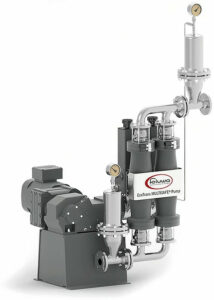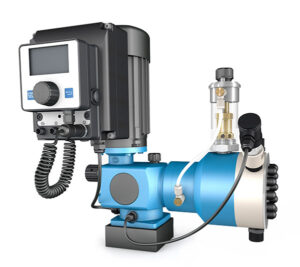
As one of the most frequently used and proven positive displacement pumps, it is not surprising that the diaphragm pump is constantly being further developed for special applications. This also applies to the conveyance of solids. Whether as a so-called double hose-diaphragm pump or, as shown here, as a solids diaphragm solution (SDS), which is based on proven piston diaphragm pump technology and supplemented by an integrated progressive cavity pump. This enables reliable and efficient pumping of media with higher solids content – even over long distances and at high viscosity.
In the first step, an progressive cavity pump ensures constant and reliable filling of the piston diaphragm pump chambers in the low-pressure range. A specially developed piston diaphragm pump then increases the pressure to the desired operating point. Thanks to its innovative design, a hermetically sealed diaphragm completely protects the actual pump from the medium being pumped. This means that only a few components come into contact with the medium, which reduces wear and tear and extends the service life of the pump.
The valves are deliberately kept simple, which not only increases service life but also enables quick and uncomplicated maintenance. This keeps your system efficient and reduces downtime to a minimum.
The system is rounded off by an AI-supported monitoring tool, the Smart Pump Assistant. It continuously analyzes operating data such as pressure, flow rate, and wear indicators, detects potential malfunctions up to three weeks in advance, and automatically optimizes maintenance cycles. This keeps your system efficient, available, and future-proof – without any manual control.
This diaphragm pump has been specially developed for the reliable transport and dosing of slurries and solids with a high dry matter content. It is ideal for industrial applications in environmental and process engineering.
Diaphragm pumps therefore can offer a very interesting alternative to the usual plunger or piston pumps for conveying media containing solids.